
Article 1: Want to Be a Doctor? These STEM Classes Could Launch Your Medical Career
Discover how your high school STEM classes lay the foundational skills, analytical thinking, and real-world knowledge required to excel as a future doctor.
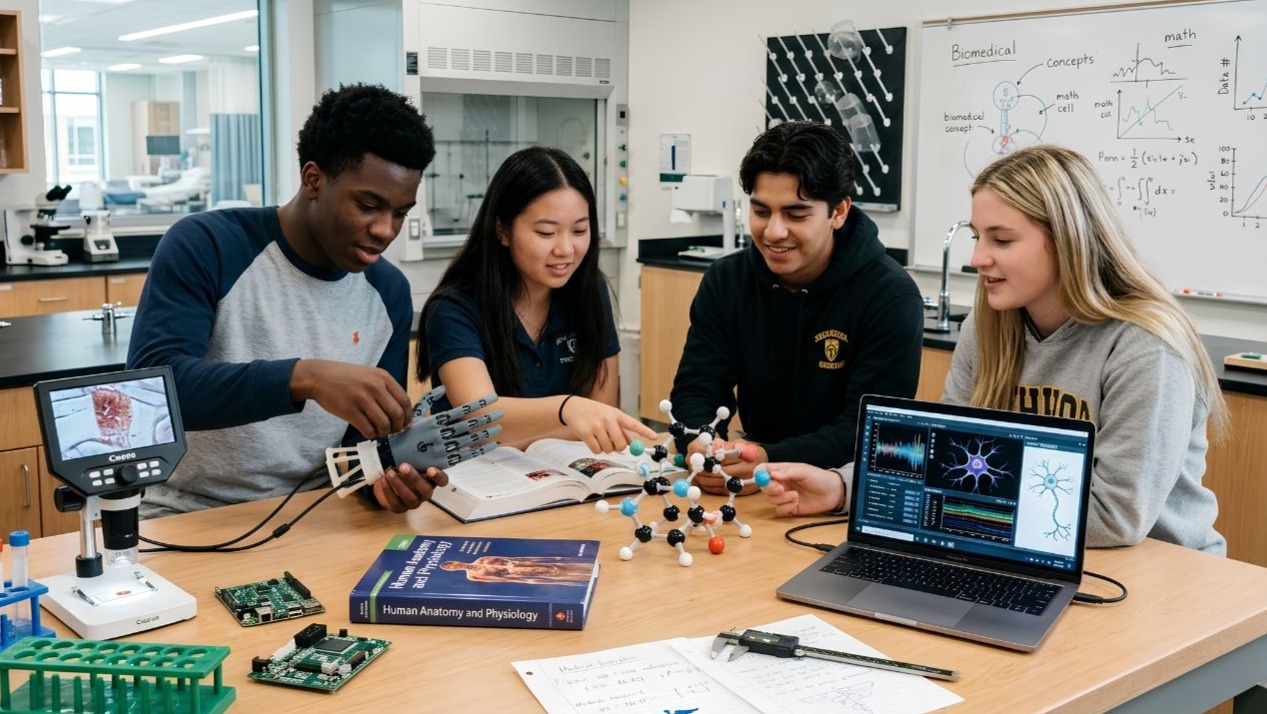
If you’re a high school student with dreams of pursuing a career in healthcare, all of your courses are important to develop your skills, but science, technology, engineering, and mathematics—also known as STEM— courses will provide foundational knowledge for ways to innovate, especially if you plan to become a doctor.
Let’s learn more from the HSAFP Executive Team about the similarities between your STEM classes and medical careers and how these courses in particular will prepare you for your future!
How STEM Prepares Students for Medical Careers
STEM courses are critical to properly prepare students for successful careers in medicine. As you probably know, each subject area plays a distinct and valuable role. Your high school STEM classes directly relate to vital skills and knowledge that physicians and other healthcare professionals use daily.
Science: Biology, chemistry, and physics classes are fundamental for medical careers.
Biology introduces you to human anatomy and physiology, while chemistry provides essential knowledge of biochemical reactions, medications, and disease processes. Physics can help you understand medical technology like X-rays and MRI machines.
Technology: Familiarity with technology is crucial due to the rapidly advancing nature of medical tools and use of AI in the operating room, the clinic, and medical school.
Classes in computer science or information technology help students become proficient in using electronic health records, diagnostic equipment, and innovative software applications in patient care.
Engineering: The principles of engineering foster critical thinking and practical problem-solving.
Biomedical engineering specifically combines these principles with medical knowledge, enabling the creation of innovative medical devices and solutions that directly improve patient outcomes.
Mathematics: And finally, everyone’s favorite: Math!! Math is essential in healthcare to accurately calculate medication dosages, analyze medical data, and interpret research statistics.
Courses such as algebra, calculus, and statistics will help to refine the analytical abilities needed to be a healthcare professional, and taking advanced or AP-level courses can further enhance your readiness for college and medical studies.
To view more about which courses to take (and when), see our blog article, “The Best High School Courses & Activities for Pre Med Students.” Furthermore, we suggest speaking with your guidance counselor or advisor about the optimal class schedule for you!
Real-Life Connections Between STEM and Healthcare
Today’s medical advancements are driven by enhancing healthcare delivery and patient outcomes. Let’s just go through a few examples of these innovative projects that use engineering, math, and technology to serve future patients across the world.
Robotic surgery allows minimally invasive procedures, significantly improving patient recovery times (see Reddy et al., 2023). Biomedical engineers utilize 3D printing technologies to create custom prosthetics (Borthakur, 2025).
There are also so many new, exciting, interdisciplinary research projects that are waiting to be initiated. See our “How High School Research Can Elevate Your College Application” article for more on interdisciplinary research, and join HSAFP to learn more about the intersection of medicine, public health, the humanities, and more!
---
Hands-On STEM Opportunities Beyond the Classroom
In addition to taking courses, we recommend exploring STEM through other avenues as well. You may consider joining STEM clubs, like Science Olympiad or robotics teams, to apply the knowledge you’re learning in AP Chem and Bio both creatively and collaboratively.
If you’re interested in medicine, you should already be volunteering at a hospital or clinic, where you can start analyzing the connections between your courses and the medical field. Delving into a research opportunity will give you more insight into the science, engineering, and math being used to create new medical tools and technologies.
HSAFP allows you to explore all of these opportunities—volunteering, research, and hands-on medical skills—and interact with high school peers across the U.S. and Canada interested in STEM.
Plan your Course(s)
Your next step is to start planning!
- Map out what courses you will take for the rest of your high school career that may help stoke or enkindle your interest in STEM and medicine with your advisor.
- Talk to your peers and explore on your own the connections between STEM courses and medicine.
- Search for volunteering and research opportunities!